Today is International Holocaust Remembrance Day.
Today we remember the more than 11 million people, Jewish and Gentile, who were slaughtered in the death camps, who succumbed to disease and the elements in concentration camps, who were sterilized to prevent the “dilution” of the “Aryan race,” who were worked to death, or nearly, in the works camps, who were imprisoned for their political or religious beliefs, who were sterilized or killed for being considered disabled, who were gassed to death in the Einsatzgruppen mobile gas chambers, who were shot into graves they had been forced the dig, and those who managed to survive all of that and were forced to remember the horrors they had seen and experienced.
May they rest in peace, may their memory be a blessing, may peace be upon them, and may we all say Never Again.
Tag: Shoah
Remember that before the Holocaust, there were 18 million Jews in the world. They killed a third of us.
Remember that pre-war Eastern Europe was the center of world Jewry, and it had a thriving Jewish society with Yiddish theater, poetry, literature, art, and political activism. An entire society was destroyed.
Remember that before the war, a third of Warsaw’s population was Jewish. The vast majority of those Jewish residents were murdered.
Remember that Salonika (Thessaloniki) was a city in Greece that had a Jewish majority for hundreds of years. It used to be known as Sabatopolis – the Shabbat city – because before electric light, ships going by on Friday night would see a dark shoreline because the residents could not light lights. In the 16th century, it was known as the “mother of Israel” and was a center of Jewish life where Eastern European Jews would come to visit and study. Fewer than 1800 Jews from Salonika survived the Holocaust.
Remember that in Krakow, what used to be the Jewish quarter is now a tourist trap for the groups who come to look at what once was. The Jewish community owns several beautiful synagogues but only regularly uses one because there are so few Jews left. Without the tour groups who regularly pray with them, they would have trouble getting a quorum of ten men by the beginning of the Shabbat service. The other synagogues are museums now.
Remember what we lost.
Remember that before the Holocaust, there were 18 million Jews in the world. They killed a third of us.
Remember that pre-war Eastern Europe was the center of world Jewry, and it had a thriving Jewish society with Yiddish theater, poetry, literature, art, and political activism. An entire society was destroyed.
Remember that before the war, a third of Warsaw’s population was Jewish. The vast majority of those Jewish residents were murdered.
Remember that Salonika (Thessaloniki) was a city in Greece that had a Jewish majority for hundreds of years. It used to be known as Sabatopolis – the Shabbat city – because before electric light, ships going by on Friday night would see a dark shoreline because the residents could not light lights. In the 16th century, it was known as the “mother of Israel” and was a center of Jewish life where Eastern European Jews would come to visit and study. Fewer than 1800 Jews from Salonika survived the Holocaust.
Remember that in Krakow, what used to be the Jewish quarter is now a tourist trap for the groups who come to look at what once was. The Jewish community owns several beautiful synagogues but only regularly uses one because there are so few Jews left. Without the tour groups who regularly pray with them, they would have trouble getting a quorum of ten men by the beginning of the Shabbat service. The other synagogues are museums now.
Remember what we lost.
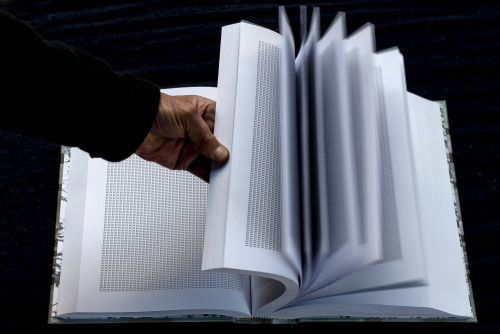
Holocaust Told in One Word, 6 Million Times.
There is no plot to speak of, and the characters are woefully
undeveloped. On the upside, it can be a quick read — especially
considering its 1,250 pages.The book, more art than literature, consists of the single word
“Jew,” in tiny type, printed six million times to signify the number of
Jews killed during the Holocaust. It is meant as a kind of coffee-table
monument of memory, a conversation starter and thought provoker.“When you look at this at a distance, you can’t tell whether it’s
upside down or right side up, you can’t tell what’s here; it looks like
a pattern,” said Phil Chernofsky, the author, though that term may be
something of a stretch. “That’s how the Nazis viewed their victims:
These are not individuals, these are not people, these are just a mass
we have to exterminate.“Now get closer, put on your reading glasses, and pick a ‘Jew,’ ” Mr.
Chernofsky continued. “That Jew could be you. Next to him is your
brother. Oh, look, your uncles and aunts and cousins and your whole
extended family. A row, a line, those are your classmates. Now you get
lost in a kind of meditative state where you look at one word, ‘Jew,’
you look at one Jew, you focus on it and then your mind starts to go
because who is he, where did he live, what did he want to do when he
grew up?”Read more here
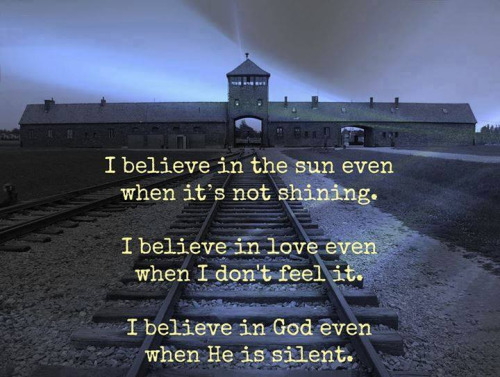
This inspiring poem was etched into a wall by a prisoner of Auschwitz Concentration Camp.
so beautiful….
 Naama's blog